Find what worksheets help speaking fluency, from...
Learn moreA worksheet that looks great but falls flat in class costs more than money – it costs time, pace, and attention. That is why choosing the right English teaching materials for kids matters so much. For busy teachers, the goal is not simply to collect attractive resources. It is to find materials that are clear, age-appropriate, easy to use, and strong enough to support real learning from the first minute of the lesson.
When children are learning English, materials need to do several jobs at once. They need to hold attention, support understanding, provide repetition without feeling dull, and fit the level of the learner. That sounds simple until you are planning for mixed ability groups, limited lesson time, and students who may love speaking but resist writing, or enjoy games but struggle with phonics. Good resources make those classroom realities easier to manage.
The best English teaching materials for kids are practical before anything else. They should help you teach a clear language point, not create extra work through vague instructions or awkward layout. In a primary classroom or tutoring session, children need materials they can understand quickly. If a task takes too long to explain, you lose momentum.
Strong materials also balance learning and usability. Flashcards should be visually clear. Worksheets should guide children step by step. Games should reinforce a target skill rather than fill time. A printable crosword, for example, can be excellent for revising vocabulary, but only if the words match what pupils already know and the clues are pitched at the right stage.
There is also a question of progression. Random activities may entertain children, but they rarely build confidence in a reliable way. Effective materials let you move from recognition to controlled practice and then to production. A young learner might first identify animal words, then match them to pictures, then use them in simple speaking practice. That sequence makes a lesson smoother and more effective.
One of the most common planning mistakes is choosing resources by theme alone. A set on food, transport, or family may look useful, but unless it matches both age and proficiency, it can still miss the mark. Young children need different support from older primary learners, even when they are studying similar language.
For early learners, materials should rely heavily on visuals, short tasks, tracing, matching, colouring, and oral repetition. The language load needs to stay light. Too much text on a page can create resistance before the task even begins. At this stage, rhythm, routine, and visual clarity often matter more than variety.
For older children, the materials can become more structured. Gap fills, reading tasks, sentence building, and simple writing activities start to make more sense. They still benefit from engaging design, but they also need resources that help them notice patterns in grammar, spelling, and sentence form. A worksheet that feels too babyish can reduce effort just as quickly as one that feels too difficult.
CEFR alignment is especially useful here. When resources are organised by level, teachers can choose with more confidence and avoid the common problem of overestimating what children can do independently. A1 learners, for instance, need very different task demands from A2 learners, even within the same topic area.
Teachers usually do not need more options. They need better filtering. In practical terms, the most useful materials are the ones you can download, print, and use with minimal adaptation. That includes worksheets with clear instructions, flashcards sized for classroom use, classroom games that do not require extensive setup, and tests with answer keys.
Answer keys are often overlooked, but they matter. They speed up marking, help with cover lessons, and make resources easier to hand over to other teachers or teaching assistants. In online teaching, they are equally useful because they reduce on-screen checking time and keep the session moving.
Skill-based organisation also saves hours. If you are planning a vocabulary revision lesson, you should be able to find vocabulary materials quickly. The same goes for phonics, grammar, reading, and speaking. Searching through mixed resource libraries is one of the biggest hidden drains on prep time.
That is where a well-organised printable library becomes more valuable than a pile of disconnected downloads. Print My English, for example, is built around that exact need: ready-to-use resources organised by skill and CEFR level, so teachers can find what fits and teach with less friction.
No single resource type works for every lesson. The right choice depends on your objective, your class size, and how independently your learners can work.
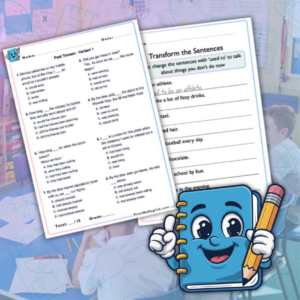
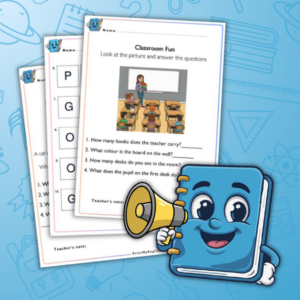
Worksheets are often the backbone of the lesson because they provide structure. They are particularly useful for guided practice, homework, quick assessment, and revision. The trade-off is that worksheets alone can make lessons feel static if every stage is paper-based. They work best when combined with oral modelling, board work, or pair tasks.
Flashcards are highly effective with younger learners and lower levels. They are quick to introduce, easy to recycle, and ideal for drilling, games, and memory work. Their main limitation is depth. Flashcards are excellent for vocabulary presentation, but they need follow-up activities if you want children to use the language actively.
Crosswords, matching tasks, word searches, and simple classroom games are useful because they increase repetition without making practice feel repetitive. That said, novelty should not replace learning aims. If a game takes five minutes to explain and only two minutes to practise the target language, it may not be the best use of lesson time.
Tests and review sheets have their place too. For children, assessment materials need to feel manageable and familiar. A short, well-designed check is often more useful than a long paper that creates stress and gives unclear results.
A professional-looking resource is not always a well-built teaching resource. Before using any material, it helps to check a few basics. Are the instructions clear enough for the age group? Is the target language accurate? Is the task doing one main job, or trying to test too many things at once? Can you see where it fits in the lesson sequence?
Layout matters more than many teachers expect. Crowded pages, tiny fonts, inconsistent images, and unclear spacing all create avoidable barriers. For children, the page itself is part of the teaching. If the design is confusing, the task becomes harder than it needs to be.
It is also worth checking whether the material is genuinely printable. Some digital resources look fine on screen but become poor classroom tools once printed in black and white or at standard paper size. For teachers working across schools, tutoring rooms, or home setups, print reliability is not a small detail.
The most efficient teachers are not starting from scratch every week. They build a resource bank they can return to, adapt, and combine. That means choosing materials with enough consistency to work across different classes and enough flexibility to support extension or simplification.
For example, a vocabulary worksheet can be used as first practice with one group and as revision with another. A set of flashcards can support presentation in one lesson and a fast warmer in the next. When materials are structured well, they become reusable rather than disposable.
This is particularly helpful for mixed teaching contexts. A classroom teacher, private tutor, and online instructor may all need the same language point taught in different ways. Printable resources are valuable because they can be adapted across one-to-one sessions, small groups, and larger classes without rebuilding the lesson from the ground up.
Children respond quickly to success and failure. If materials are too easy, they switch off. If they are too hard, they often stop trying. Good teaching resources help you find the middle ground where learners can complete tasks, notice progress, and stay willing to participate.
That is why dependable English teaching materials for kids are not just a convenience. They affect classroom flow, learner confidence, and your own ability to teach without constant improvisation. The strongest resources reduce unnecessary effort while keeping the lesson purposeful.
If a material helps you explain less, practise more, and keep children engaged from start to finish, it is doing exactly what it should. Choose resources that earn their place in the lesson, and planning becomes lighter while teaching becomes more confident.
Find what worksheets help speaking fluency, from...
Learn moreReduce teacher workload with practical planning systems,...
Learn moreTests versus quizzes serve different classroom purposes....
Learn moreThis guide to printable spelling activities helps...
Learn more