Find what worksheets help speaking fluency, from...
Learn more
One learner can explain a grammar rule perfectly and still miss every gap-fill on the page. Another races through sentence transformations but falls apart when a collocation changes. That is exactly where the use of English worksheets earns its place. Used well, they do more than test grammar. They help teachers pinpoint accuracy problems, recycle language efficiently, and turn weak spots into teachable moments without building every exercise from scratch.
For busy teachers, that matters. A good worksheet gives structure, keeps the lesson moving, and makes it easier to see what students can actually do with grammar, vocabulary and form. A weak one does the opposite. It creates busywork, muddies the target language, and leaves you marking errors without learning much from them.
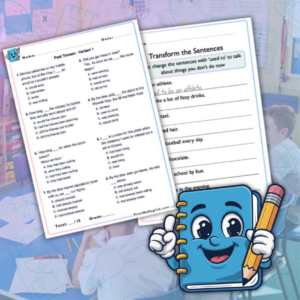
In many classrooms, the use of English worksheets sits between pure grammar practice and full productive work. It focuses on how language works in context – not only the correct tense or preposition, but word formation, fixed phrases, sentence transformation, register and accuracy under pressure.
That makes these worksheets especially useful when students seem to “know” a language point but cannot apply it reliably. A short worksheet can reveal whether the problem is understanding, memory, speed, or interference from a first language. That is valuable information when you are planning the next step.
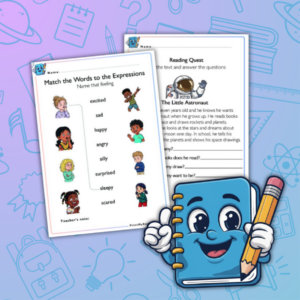
They are also practical across levels. At A1 or A2, the worksheet may focus on articles, basic verb forms and simple vocabulary sets. At B1 and B2, it often moves into phrasal verbs, dependent prepositions, word formation and controlled transformations. At C1 and C2, the task can challenge precision, nuance and formal accuracy. The format stays familiar while the language demand changes.
These resources are most effective when the goal is clear. If you need students to notice a pattern, consolidate recent teaching, prepare for an exam task, or diagnose recurring mistakes, a worksheet is usually a good fit. If you want spontaneous discussion or extended fluency, it should be only one part of the lesson.
That distinction matters because some teachers expect too much from one page. A worksheet can sharpen accuracy and support retrieval, but it will not replace speaking, writing feedback, or meaningful exposure to language in use. The strongest lessons treat it as a focused tool, not the whole method.
This is why timing matters too. Early in a lesson, a worksheet can activate prior knowledge and show where to slow down. Mid-lesson, it can give controlled practice after teaching. Later, it can work as review, homework or quick assessment. The same resource can serve different purposes depending on where you place it.
Not all worksheets save time. Some create more work because they are poorly levelled, unclear, or packed with random item types that do not match your lesson aim. Choosing well is what protects your prep time and improves results.
First, match the worksheet to the language point and the learner level, not just the topic name. A sheet labelled “present perfect” may be suitable for one B1 group and completely wrong for another if the examples assume vocabulary students do not know. CEFR alignment helps here because it narrows the range and makes resource selection faster.
Second, look at task design. Clear instructions, clean layout and consistent item types reduce confusion. If students need five minutes just to understand what to do, the worksheet is not efficient. Ready-to-print resources with answer keys are especially useful in real teaching conditions because they reduce admin time and support quick checking.
Third, consider whether the worksheet gives you usable feedback. Ten isolated multiple-choice items may be fine for a quick check, but they reveal less about student thinking than sentence transformation, error correction or open cloze work. It depends on your aim. If you want speed, choose controlled practice. If you want insight, choose tasks that expose patterns of error.
The difference between a productive worksheet lesson and silent page-filling usually comes down to staging. Before students begin, give a short lead-in that narrows attention to the target language. That might be two model sentences on the board, a quick reminder of a form, or one common mistake from the last lesson.
Then set a tight purpose. Tell students what to watch for – tense choice, word family, collocations, missing auxiliaries, or register. This small step improves accuracy because learners are not approaching the page blindly.
While they work, avoid treating the worksheet as dead time. Monitor for patterns rather than correcting every item immediately. If four students miss the same structure, pause and address it once. That saves time and keeps feedback focused.
After checking answers, go one step further. Ask why an answer is correct, what alternative form would be wrong, or which clue in the sentence helped. This moves the task away from simple answer collection and towards actual language awareness.
A useful follow-up is to recycle the target language in a second format. Students can write one new sentence, correct a partner’s error, or use two of the target items in a short speaking task. That is often where the worksheet starts to transfer into usable language.
The most common issue is overuse. When every lesson includes another gap-fill, students can become fast at completing exercises without becoming more accurate in real communication. Variety matters, even when the worksheet itself is strong.
Another problem is choosing worksheets that are too hard because the class is preparing for a higher-level exam. Ambition is understandable, but materials need to sit close enough to current ability for students to notice patterns and improve. If every item feels out of reach, the worksheet becomes discouraging instead of diagnostic.
There is also the marking trap. If checking takes longer than the practice itself, the task was probably too dense or too unfocused. Shorter, well-targeted worksheets often produce better teaching value than long mixed pages.
Finally, some teachers use these materials without adapting them. That is a missed opportunity. Removing two items, adding one example, or pairing a worksheet with a quick speaking extension can make a standard resource much more effective for a specific group.
In one-to-one lessons, English worksheets can be highly efficient because feedback is immediate. You can stop at the exact point of confusion and build a mini-explanation around it. This makes even a short worksheet do a lot of work.
In small groups, pair checking is useful, but only if you control it. Stronger students can dominate answer discussion, so it helps to assign roles or ask each pair to justify two specific items rather than compare the whole sheet quickly.
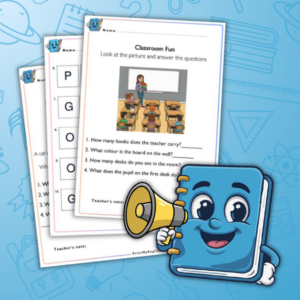
In larger classes, layout and task clarity become even more important. You need materials that students can begin confidently with minimal explanation. Professionally designed worksheets tend to perform better here because formatting, sequencing and answer support reduce avoidable classroom friction.
Online teaching changes the mechanics, not the principle. Students still need focused tasks, clear instructions and concise feedback. A printable worksheet can be shared on screen, completed independently, or used as homework before a feedback lesson. The key is to keep the correction stage active, not simply display answers.
Teachers often collect dozens of worksheet files and still feel underprepared. Usually the problem is not lack of material. It is lack of dependable material. When resources are well reviewed, levelled properly and designed for classroom use, planning becomes faster and teaching becomes steadier.
That is where a structured library helps. Being able to find a worksheet by skill area and CEFR level removes a large part of the search burden. For teachers balancing multiple groups, mixed abilities and limited prep time, that kind of organisation is not a luxury. It is operationally useful.
Print My English reflects that practical need. The value is not simply in having downloadable worksheets, but in having ready-to-use materials that fit real lessons, include answer keys and reduce the time spent second-guessing quality.
A successful worksheet lesson is not one where students finish every question. It is one where you leave with a clearer picture of what they can control, what still slips, and what should come next. Sometimes that means high scores. Sometimes it means noticing one stubborn error pattern that finally explains why writing or speaking has plateaued.
That is the real strength of English worksheets. They create a controlled space where language becomes visible. For teachers, that visibility leads to better decisions. For learners, it builds the kind of accuracy that supports confidence rather than just test performance.
The best resource is the one that saves you time and gives you something useful back. If a worksheet helps you teach the next lesson better, it has done its job.
Find what worksheets help speaking fluency, from...
Learn moreReduce teacher workload with practical planning systems,...
Learn moreTests versus quizzes serve different classroom purposes....
Learn moreThis guide to printable spelling activities helps...
Learn more