Find what worksheets help speaking fluency, from...
Learn more
A beginner lesson can fall apart for a simple reason: the material asks too much, too soon. A worksheet with dense instructions, a vocabulary set with no clear context, or a speaking task that assumes too much confidence can turn a manageable lesson into a frustrating one. That is why choosing the best English learning materials for beginners matters so much. For teachers, tutors and schools, the right resources do more than fill lesson time – they create early success, reduce preparation pressure and help learners feel capable from the start.
For true beginners, good materials are not just easy. They are carefully controlled. Language needs to be limited enough to feel achievable, but still useful enough to support real communication. That balance is where many resources miss the mark.
The strongest beginner materials usually share a few features. Instructions are short and clear. The visual layout is clean, with enough white space to avoid overload. New vocabulary appears in a meaningful context rather than as an isolated list. Grammar is introduced in small steps, with repetition built in. Most importantly, tasks give learners something they can complete successfully, even if their English is still very limited.
This is also where classroom practicality matters. Teachers rarely need a resource that looks impressive but takes twenty extra minutes to explain. They need materials that can be printed, handed out and used with confidence. Answer keys, level labels and clear task aims save time and improve lesson flow.
One of the most common planning mistakes is choosing a resource because the topic looks engaging, then realising the language load is too high. With beginners, level comes first. A familiar topic like food, family or daily routines can still fail if the sentences are too complex or the task requires too much independent production.
A better approach is to begin with what learners can already process. At A1 level, that usually means high-frequency vocabulary, short model sentences and very clear task types such as matching, labelling, gap fills, simple reading checks and controlled speaking prompts. Once that foundation is secure, the topic can expand.
CEFR labelling helps here because it gives teachers a quicker way to judge suitability. It is not perfect – some A1 classes move faster than others – but it is a useful filter. If you are teaching mixed-ability beginners, it is often safer to choose lower-demand material and extend it in class than to spend time simplifying a worksheet that was never designed for that level.
Not every resource format carries the same weight in a beginner classroom. Some formats support confidence and repetition. Others create unnecessary strain.
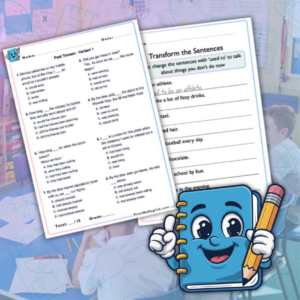
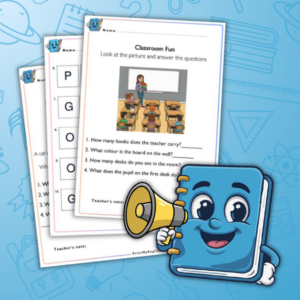
Printable worksheets remain one of the most dependable choices for beginner teaching because they provide structure. A well-designed worksheet can guide learners from recognition to controlled practice in a way that feels manageable. For example, a vocabulary worksheet might begin with picture-word matching, move to gap fills, and then finish with a short personalised sentence task.
This progression matters. Beginners need repeated exposure before they can produce language independently. Worksheets help teachers pace that process without having to build each stage from scratch.
Visual learning tools are especially useful at beginner level because they reduce the need for lengthy explanation. Flashcards can support vocabulary presentation, drilling, pair work and games, all with the same set of materials. They are also flexible across age groups. Young learners may use them for movement activities, while adult learners may use them for quick retrieval practice or speaking prompts.
The trade-off is that visuals alone are not enough. Learners still need written reinforcement and opportunities to use the target language in context. Flashcards work best as part of a sequence, not as the whole lesson.
Beginners need support in all four skills, but not in equal proportions at every stage. Early reading and listening materials should use highly familiar vocabulary and predictable structures. Writing tasks should be short and scaffolded. Speaking tasks should offer models and sentence frames rather than open-ended questions that leave learners silent.
Skill-based pages are effective when they isolate a manageable target. A beginner reading task, for instance, should not also test advanced inference, difficult spelling and unfamiliar grammar at the same time. Good resources teach one step at once.
Games, crosswords and simple communicative activities can be excellent beginner tools if they reinforce known language rather than introduce too much at once. They are particularly useful for revision and for improving participation in groups that are nervous about speaking.
However, they only work when the rules are clear and the language demand stays controlled. If a game requires repeated teacher explanation, it may not save time. The best beginner activities feel straightforward from the first round.
Teachers do not always have time to inspect every page in detail. A quick quality check can save a great deal of frustration later.
Start with the instructions. If they are wordy, inconsistent or harder than the task itself, the material is probably not beginner-friendly. Then look at the layout. Crowded pages, tiny fonts and too many task types on one sheet can increase cognitive load.
Next, check the language sequence. Does the worksheet introduce vocabulary before asking learners to use it? Does it provide examples? Is the grammar limited to one clear point? Resources for beginners should feel intentionally narrow. Breadth can come later.
It is also worth checking whether the material includes an answer key. That may sound basic, but for busy teachers, especially those planning several classes or covering different levels, answer keys reduce marking time and support consistent delivery. Reliable materials should make the teacher’s job easier, not add another layer of work.
The best resource on paper may still be the wrong one for your setting. Context changes what is useful.
In one-to-one lessons, materials need enough flexibility to allow for pacing changes and personalised follow-up. A rigid worksheet can work, but only if it leaves room for extension. In larger classes, clarity becomes even more important. Resources with simple instructions, quick checking tasks and reusable formats tend to work better because they reduce classroom management strain.
Online teaching adds another consideration. Printable materials can still be highly effective if they are cleanly formatted and easy to display or send in advance. Tasks that rely on physical movement or card sorting may need adaptation, while reading, writing and visual vocabulary work often transfer well.
For schools and language centres, consistency matters. When materials are organised by skill and CEFR level, teachers can plan more efficiently across multiple classes. That kind of structure helps departments maintain teaching quality without every teacher having to create resources independently.
There is a temptation to think that creating your own beginner materials will always be more tailored. Sometimes that is true. If you are addressing a very specific learner need, a custom worksheet may be the best option.
But in everyday teaching, the cost is usually time. Writing, formatting, proofreading and levelling a worksheet properly takes longer than most teachers can spare. It also introduces inconsistency. One week’s handout may be excellent, the next may be rushed.
Ready-to-print resources solve a practical problem. When they are professionally designed, level-appropriate and pedagogy-focused, they reduce preparation time without lowering standards. For busy teachers, that is not a luxury. It is part of staying effective over a full teaching week. A platform such as Print My English fits naturally into that workflow because it helps teachers find beginner materials by skill and level, then use them immediately.
If you are selecting materials for a beginner class, it helps to think in sequence rather than in individual pages. Start with a visual or vocabulary lead-in. Follow with a controlled worksheet that checks understanding. Add a short speaking or writing task with sentence support. Finish with a quick review game or recap activity.
This approach keeps the lesson achievable while giving learners repeated contact with the same language. It also makes resource selection easier. Instead of asking whether one worksheet can do everything, ask whether each material handles one stage well.
That is usually the difference between a lesson that feels calm and productive and one that feels like constant repair work. Beginners do not need more content. They need the right content, in the right order, with enough support to succeed.
When choosing materials, aim for resources that reduce confusion, protect lesson time and give learners early wins they can recognise. If a beginner leaves class able to read a short text, complete a simple task and say something correctly with confidence, the material has done its job. That is the standard worth planning for.
Find what worksheets help speaking fluency, from...
Learn moreReduce teacher workload with practical planning systems,...
Learn moreTests versus quizzes serve different classroom purposes....
Learn moreThis guide to printable spelling activities helps...
Learn more