Find what worksheets help speaking fluency, from...
Learn more
A useful worksheet is not automatically a time-saving worksheet. Teachers still lose precious planning time adapting an unclear task, searching for the missing answers, or discovering that the language level is wrong for the class. The question of which ESL materials save time comes down to more than whether a resource looks polished. It needs to be ready for the learners in front of you, simple to prepare, and easy to run confidently.
For busy classroom teachers, tutors and online instructors, the best materials remove work at every stage: choosing an activity, preparing it, explaining it, checking learning and reusing it later. Here is what to look for.
The most efficient ESL resources have a clear teaching purpose and require little or no rebuilding. They should tell you what learners will practise, suit a recognisable level, and include enough support for you to use them without writing a second lesson around them.
A ready-to-print vocabulary worksheet, for example, can save ten minutes before a lesson. A carefully levelled worksheet with instructions, a focused task sequence and an answer key can save time before, during and after the lesson. That difference matters when you teach several groups, cover a colleague’s class or plan lessons between appointments.
Resources organised by CEFR level are among the quickest to choose well. A1 learners may need picture-supported matching, controlled gap fills and short sentence practice. B2 learners may benefit more from collocation work, error correction or discussion prompts built around a reading text. When level information is clear, you avoid downloading several options and testing each one against your class.
The key is specificity. A worksheet labelled simply “grammar” creates another decision. One labelled for B1 past perfect practice, with a defined outcome, gives you a reliable starting point immediately. It also makes differentiation easier: select a simpler task for learners who need more support and a more demanding follow-up for early finishers.
Levelled materials do not remove professional judgement. A mixed-ability class may still require two versions of an activity or extra speaking support. However, beginning with an appropriate level is far quicker than simplifying a dense text or inventing extension work from scratch.
Answer keys are one of the smallest features with the greatest practical value. They let teachers check accuracy before class, monitor independent work without second-guessing the task, and mark written practice more efficiently afterwards.
They are especially useful for cover lessons, homework and stations where learners work at different speeds. A clear key allows pupils to self-check at an appropriate point, freeing you to support those who need explanation rather than spending the whole lesson confirming individual answers.
Not every activity should be self-marked. Open speaking tasks, creative writing and discussions need teacher feedback, peer response or a model answer rather than a single key. Yet a balanced lesson often includes one controlled, checkable stage. Choosing resources that provide the answers for that stage protects your time for the feedback that requires your expertise.
High-quality flashcards save time because they work across lesson types. The same set can introduce new language, prompt retrieval practice, support a game, provide pair-work prompts or help learners revise at the end of class. For young learners and beginners, clear visuals also reduce the amount of explanation needed.
Reusable does not mean using the same activity repeatedly without purpose. A food flashcard set might support vocabulary presentation one day, categorising countable and uncountable nouns the next, then a role-play in a café. The resource stays useful because the task changes while preparation remains light.
For in-person teaching, printable cards are often more dependable than activities that rely on a device, an account or a stable connection. For online teaching, the same visual material can be shared on screen or used as a prompt in a digital whiteboard. Choose designs that remain legible when printed in different sizes and do not depend on tiny text.
Crosswords and word searches can be efficient review tools when they reinforce language already taught. They offer an independent task while you work with a small group, settle a class at the start of a lesson, or provide a purposeful finish for learners who complete another activity early.
Their limitation is equally clear: a puzzle alone is not a full language lesson. It may check spelling and word recognition without requiring learners to use the target language in context. Save time by using it for the right job. Pair a vocabulary crossword with a brief oral follow-up, such as asking learners to make sentences using three answers, rather than expecting the puzzle to do all the teaching.
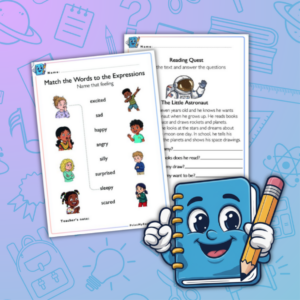
The best print-and-go activities include the instructions, materials and structure needed for learners to begin quickly. Matching tasks, information gaps, board games, sentence-building cards and role-play sheets can all work well when the setup is obvious and the language target is focused.
Before relying on any classroom activity, check the practical details. Does it need cutting? Are there enough copies or cards for your class size? Can instructions be understood in under a minute? Does the task have a natural stopping point? A resource may be academically sound but still cost time if it requires extensive assembly or leaves learners unsure what to do.
This is where professionally designed printable materials earn their place. Consistent layouts, clear directions and sensible page design reduce the friction between downloading a resource and teaching with it. Print My English materials are designed around that practical need, with skill-based resources, CEFR organisation and answer keys that help teachers move from planning to classroom use quickly.
Time-saving materials work best within a simple system. Instead of searching from the beginning for every lesson, keep a small bank of dependable resources organised by level, skill and topic. You might save separate folders for A2 speaking, B1 grammar review, exam preparation or warmer activities.
When you find a worksheet that works, note how you used it. A short file name such as “B1 travel reading – pair discussion added” is often enough to make the resource faster to reuse next term. If your school allows it, keep a few printed copies of your most flexible activities ready for unexpected cover or a lesson that finishes early.
It also helps to plan in repeatable lesson patterns. For example, use a visual warmer, a controlled practice worksheet, then a communicative task. The content changes, but the lesson shape remains familiar to you and to your learners. Familiar structures reduce instructions and make it easier to spot where a resource fits.
Free resources can be excellent, but free browsing is not always free in time. A worksheet may have attractive graphics but unclear aims, awkward language, inconsistent formatting or no answers. If you routinely spend fifteen minutes correcting, reformatting or finding an alternative, it is not truly a shortcut.
Likewise, heavily customised materials can be worthwhile for a high-stakes observation, a specialist learner need or a topic your class genuinely cares about. The aim is not to eliminate tailoring altogether. It is to reserve your limited planning time for the changes that improve learning, rather than spending it rebuilding standard vocabulary, grammar and skills practice.
Be cautious with oversized resource packs, too. More pages do not necessarily mean more value. A concise activity that targets one clear language point is often easier to teach and assess than a twenty-page pack containing several unrelated exercises.
Ask four practical questions: Is the level right? Is the learning aim clear? Are instructions and answers included where needed? Can I use this with minimal preparation?
If the answer is yes, the material is likely to support both efficient planning and purposeful teaching. If one answer is no, decide whether the required adjustment is worth the time. A two-minute change may be sensible; a complete redesign is usually a sign to choose a better starting resource.
The right ESL materials do more than fill a lesson. They give you back the time to listen to learners, respond to misconceptions and make the teaching decisions no worksheet can make for you.
Find what worksheets help speaking fluency, from...
Learn moreReduce teacher workload with practical planning systems,...
Learn moreTests versus quizzes serve different classroom purposes....
Learn moreThis guide to printable spelling activities helps...
Learn more