Find what worksheets help speaking fluency, from...
Learn more
A strong grammar lesson does not need a long explanation followed by a page of isolated questions. The most useful use of English activity examples give learners a clear reason to notice a language pattern, try it, receive feedback and use it again. For busy teachers, that means less time creating tasks from scratch and more time responding to what the class actually needs.
Use of English activities can support general English lessons, exam preparation, tutoring and mixed-ability classes. The best format depends on the language point, the learners’ CEFR level and the time available. A five-minute correction race may be ideal for revising articles with B1 learners, while a C1 group preparing for an exam may need a carefully structured key word transformation task.
A useful activity has one clear learning focus. If students are practising past tenses, avoid adding unfamiliar topic vocabulary, complex reading demands and several new grammar rules at the same time. This makes it easier to identify whether an incorrect answer comes from a grammar gap or from a misunderstanding of the task.
It should also provide enough repetition to reveal a pattern without becoming mechanical. Learners need several chances to make a choice, compare options and explain their thinking. Short answer keys are valuable, but a brief reason for the answer is often where the learning happens.
Finally, choose a response format that suits your classroom. Individual written work can show what each learner can do independently. Pair work encourages discussion and self-correction. Whole-class tasks are efficient for quick review, but they can hide uncertainty if confident pupils answer first.
Prepare four to six short sentences containing one error each. Place them around the room or display them on separate slides. In pairs, learners move through the stations, correct each sentence and write a short reason for the change.
For A2 learners, focus on one familiar area, such as subject-verb agreement: “My brother play football on Saturdays.” At B1 or B2, combine common problem areas in a short email, including prepositions, articles and verb forms. The final check matters: ask pairs to compare one answer with another pair before revealing the key.
This activity works well at the start of a lesson because it quickly shows which points need reteaching. It is also easy to adapt for online teaching by using numbered slides or a shared document.
Multiple-choice questions are most effective when every option represents a believable learner error. Avoid obviously wrong distractors. If the target is “used to”, for example, the options should test past habits, present routines and a possible confusion with “be used to”.
Give students a short context first: “When I was at primary school, I walked to school every day.” Then ask them to choose the sentence that has the same meaning. After they choose, ask pairs to explain why the other options do not fit. This turns a quick worksheet question into a language-focused conversation.
For lower levels, use pictures and short sentences. For higher levels, use context-rich examples that test register, collocation or subtle differences in meaning. A C1 class may need to distinguish between words such as “economic” and “economical”, not simply select the grammatically correct form.
Word formation activities help learners see that vocabulary and grammar are connected. Create a grid with a base word, such as “success”, and ask learners to complete related forms: succeed, successful, successfully and unsuccessful. Then place the forms in short sentences with clues from the surrounding grammar.
At A2 level, limit the task to common noun, adjective and adverb endings. At B2 and above, include negative prefixes, spelling changes and less predictable forms. Rather than presenting a long list of rules, let students group words they notice: -ment nouns, -ful adjectives or negative prefixes such as un-, in- and dis-.
A useful follow-up is a short personalisation task. Learners write two true sentences using different forms from the grid, then exchange them with a partner. This prevents word formation from becoming a purely test-style exercise.
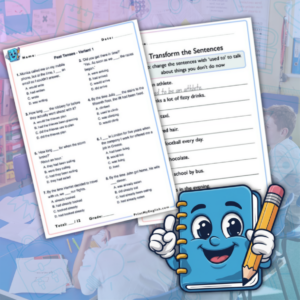
Key word transformations are often associated with exam classes, but the basic idea is useful at every level. Give students an original sentence, a key word and a second sentence with a gap. They must complete the gap without changing the key word.
For example: “It is not necessary for you to bring food.” Key word: HAVE. “You ______ bring food.” The answer is “do not have to”. The task checks form and meaning together, and it gives teachers a fast way to spot confusion between obligation, advice and necessity.
Keep transformations short for A2 and B1 learners. For B2-C2 groups, use phrasal verbs, inversions, reported speech and fixed expressions. The trade-off is that more difficult transformations can become a puzzle rather than meaningful practice. Follow them with a speaking prompt where learners use the target form in a realistic situation.
A gap-fill text is more engaging when it has a clear communicative setting. A café review, a school notice, a holiday message or a short workplace email gives learners context for choices involving tense, linking words, quantifiers or articles.
Use an open cloze when you want learners to supply grammar words such as “although”, “which”, “at” or “the”. Use a multiple-choice cloze when the focus is lexical choice, collocation or phrasal verbs. Do not make every gap equally difficult. A few accessible answers help learners build confidence before they tackle the more demanding items.
Before checking answers, ask students to underline the words around each gap that helped them decide. This simple step encourages strategies they can use in independent reading and formal assessments.
For classes that need more speaking, turn grammar revision into an information-gap activity. Prepare prompts such as “Find someone who has visited another country this year” or “Find someone who can cook a meal without a recipe.” Learners circulate, ask questions and note names.
The language must match the aim. If you are revising present perfect, model the question and a natural follow-up: “Have you visited another country this year?” “Yes, I have.” “Where did you go?” The follow-up moves students from controlled grammar to genuine interaction.
This activity is not always suitable for a quiet one-to-one lesson or a class with limited space. In those cases, students can interview a partner or work from fictional character cards instead.
CEFR labels are useful planning tools, not fixed limits. An A1 learner may manage a challenging topic if the language demand is simple, while a B2 learner may struggle with an unfamiliar task format. Start with what students need to do, then adjust the amount of support.
At A1-A2, use short instructions, visual prompts and one language point at a time. Build in examples before independent practice. At B1-B2, students can compare alternatives, justify answers and work with longer texts. At C1-C2, activities can focus on precision, register, idiomatic language and grammatical choices that change emphasis or tone.
A well-organised printable resource library makes this differentiation faster. Print My English materials can be selected by skill area and CEFR level, helping teachers choose classroom-ready practice without spending an evening reformatting exercises or producing answer keys.
A dependable use of English lesson can follow a short sequence: begin with a quick diagnostic task, teach or clarify the pattern students need, then give focused practice before a final task that requires them to use the language more freely. This structure is effective because each stage has a purpose.
For example, start a B1 lesson on comparatives with three incorrect sentences on the board. Clarify the form based on the errors you see, use a short worksheet for controlled practice, then ask groups to compare two local places, films or holiday options. Collect a few examples at the end and correct them anonymously with the class.
Ready-to-print activities are particularly useful when you need to change pace during a lesson. Keep a small bank of level-appropriate grammar games, cloze texts and transformation tasks available for early finishers, revision lessons or unexpected timetable changes.
The most effective activity is not necessarily the longest or most elaborate one. Choose a task that gives learners a manageable challenge, makes their thinking visible and leaves you with a clear next step for teaching. When students can explain why an answer works, they are building knowledge they can use beyond the worksheet.
Find what worksheets help speaking fluency, from...
Learn moreReduce teacher workload with practical planning systems,...
Learn moreTests versus quizzes serve different classroom purposes....
Learn moreThis guide to printable spelling activities helps...
Learn more